





A refugee boy and his father are changed by the appearance of a mysterious object in the night sky.
Short story | 2,980 words
He opens the plastic box, snap by snap. The outside is moldy with water damage, but the inside seems clean. The box has done its work. He pulls out the drawings, made with Crayola markers in a child’s hand, eight or nine years old. The papers are different shades of yellow, but the memories are clear. They come flooding to him now.
The drawing in his hand is of a mysterious object, an oblong shape, hovering over squares in a rectangle. That apartment building was their first home in Brampton. They had left everything during the war, and found their way to Canada, watching the twenty-four-hour news when their family was living it. Canada felt safe, until the oblong shape arrived.
That drawing takes him back to a night in those early years, a terrible night that would change the lives of a boy and his father.
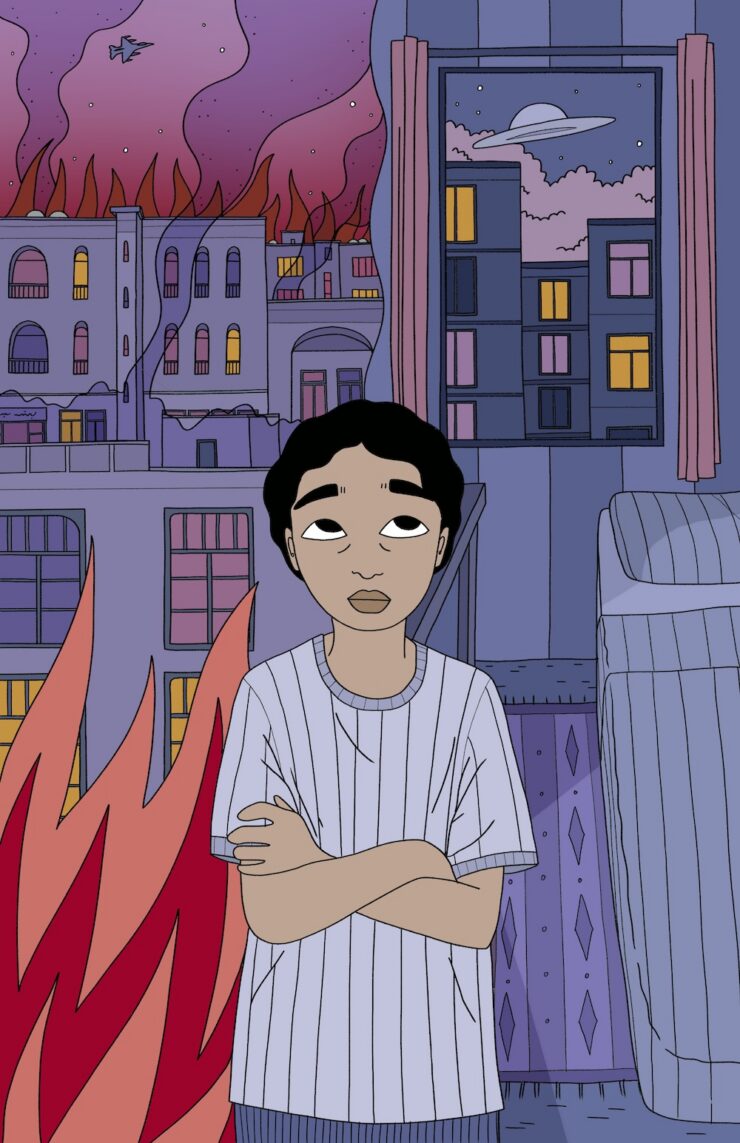
Hadi sat at his window, watching the night sky. His heart was thumping. In his hand was a camcorder with a compact VHS tape, paused somewhere toward the end. He was determined to get evidence of what he had seen, what his father had refused to believe, what the teachers at school said was just a nightmare.
Fahad slept in the room next door, unaware of this plan. His gentle snoring echoed through the apartment like ambient noise. His mustache twitched with some terrible dream. There were so many sleepless nights of late that he took the help of a little pill. Without it, he might have been awake by now.
The night is empty. Hadi feels crushed by the weight of it. His heart feels empty too, ever since they moved to Canada. He misses his friends back home, his menagerie of toy animals, his house with rooms to run through. Most of all, he misses his mother.
This camcorder is all he has left of her. Nora wanted to stay in Kuwait, or so his father said, to be with her parents during the war. She never told him in person, though. He woke up one night in an empty house, with bombs thundering outside. He ran through empty rooms, crying out for his mama, his baba. He could still hear the echoes of his voice in the night. When his father came home, he looked bewildered. He said, “We have to go.” They packed the car and drove through the desert. They never went back.
Hadi wondered, sometimes, if his mother even loved him.
“Of course she does,” his father would say. “She wanted to keep you safe. That’s why we’re here.”
“Why didn’t she come?”
“She’s with her parents and her brother.”
“I wish she was the one here and you were the one there.”
After a painful silence, Fahad would whisper, “Me too.”
Canada is safe, or so his father said. But Hadi did not understand it. He had to learn a new language, a new way of being, of dressing, of cartoons to watch, cereals to eat, playing something like soccer but with a stick and a tennis ball. The kids at his elementary school laughed at the strangest things. He never knew what they would laugh at him for.
Now he sat looking at the black squares of an apartment building. Each of those windows held a life he did not understand. He would watch them during the day, in their strange little rituals. The woman who did her step aerobics in neon tights, the old couple who drank wine and read books in silence, the family who played charades and made funny faces at each other. He was surrounded by people in his little apartment, but he felt isolated.
They were sleeping now, his neighbors, all except one in a window with flickering light. Hadi noticed it. There was a boy there, slouched over in bed with his Nintendo controller. He was there all the time, day and night, while his parents existed in the next window over. They never talked except when they were shouting at each other. Hadi wondered about the boy. Maybe he, too, felt the emptiness.
The moon came out. There was no sign of the mysterious object that night. Hadi wondered if it would come at all, but he could not risk falling asleep, exposed by the window like this. It was too dangerous.
The first night it appeared, he did not see the mysterious object itself, he only heard the helicopter chasing it. He woke up to a thumping noise, he thought it was a nightmare, but it became louder like the beating of his heart. Outside was a black helicopter, without lights, just a silhouette across the stars.
Hadi thought it was the war coming after them. He tried to tell his father, but his father said it was just a nightmare and went back to sleep. So, Hadi took action: he turned the faucet on to fill up the bathtub, in case the water ran out, and found the duct tape, and started to tape over the windows, in case there was an explosion nearby. This is what you do in an invasion.
He should have answered the doorbell when it rang over and over, but he was scared to talk to a neighbor, so his father was the first to find out about the leak. Hadi got in trouble for the bathtub, and the duct tape, and confusing nightmares with reality, and making their lives much harder than they need to be, so far away from home.
It was Lucy at school who made sense of his experience. She overheard him asking Ms. Connolly about the helicopter last night. “It was just a nightmare,” said Ms. Connolly. “There’s no invasion here.”
Lucy found him during recess and pulled him into the janitor’s closet, where she could whisper her secret. “There is an invasion,” she said. “They don’t want you to know it.”
She told him what happened just the year before in Carp, Ontario. A mysterious object crashed onto a farm, a silver disk with strange creatures inside, who looked like people but with black, empty eyes. The farmer and his wife brought over their camcorder, but before they could record the video, a helicopter chased them away and picked up the wreckage.
“They don’t want you to know,” said Lucy, “because the invasion is from space.”
“From space?” said Hadi. “What do they want?”
Lucy looked menacing under the light bulb of the janitor’s closet. She told him about alien abductions, and the strange experiments, and the nightmares people come back with. “The truth is: no one really knows what they want. But you might find out.”
“Why me?”
“I don’t know. But if the aliens were there last night, outside your window, they might be coming for you.”
That terrible thought kept Hadi awake at night. He refused to sleep alone. He slept on the floor in his father’s bedroom. He asked about every alien sound, the radiator, the garbage truck, the elevator mechanism turning.
Fahad tried to reassure him, patiently. “There is no such thing as aliens,” he said. “If there were, they would be mentioned in the Quran.”
“They’re not?” asked Hadi.
“No.”
After a thoughtful pause, he asked, “What about dinosaurs?”
It became worse one night when Hadi had to use the bathroom. He ran down the small dark hallway, exposed to a window in the living room, and another through the open door to his empty bedroom. Everything seemed fine, he did his business, and washed his hands, but when he stepped back into that hallway, he saw the object.
It was a silver disk hovering outside the living room window.
It looked strange and kind of peaceful.
Hadi stood mesmerized by it.
Then it moved toward him. He panicked and ran into his empty bedroom and slammed the door. There was a hovering sound, and the object appeared outside his bedroom window. He ran back out into the hallway, into his father’s bedroom, under the covers.
“What!” Fahad snapped. “What?”
“They’re here!” said Hadi. “They’re coming after me!”
When his father pulled the covers off, Hadi screamed; he thought it was the end. But there was nothing outside. Just the empty sky and the black squares of the apartment complex. They searched for what felt like hours, standing at the window, the boy convinced that what he saw was real, the father convinced it was a nightmare.
“Maybe they saw you and got scared?” said Hadi.
“Maybe,” said Fahad.
He knew this would be their life for a long time to come. It was a surprise, then, when Hadi came to him one night and said, “I’m going to sleep alone.”
“Why?”
“I’m almost ten. That’s two numbers.”
“That’s right,” said Fahad. “I’m proud of you,” he added.
He did not know that his son had stolen the camcorder from a locked drawer and was planning to expose himself to the terrors of the night, so he can get evidence of an alien invasion and prove that his nightmares were real.
Hadi sat at the window, but there was no sign of the aliens. Just an empty sky, and the black squares, and the boy playing video games in flickering light. Hadi could not allow himself to sleep. He picked up the camcorder, hit Rewind, and started to watch the home videos.
These were the memories of his mother in the black and white of a viewfinder. She had the warmest smile. She liked to sing. She played soccer with him outside. She made a party for his birthday, with vanilla cake and helium balloons. He was surrounded by children. They were happy in that house. She sang him a lullaby to sleep, and though he could not hear the audio from the camcorder, he could hear the voice in his heart.
He fell asleep to it.
Hadi woke up to a hovering sound and a tingling throughout his body. From his angle on the floor, he could only see a small patch of night. The silver disk was there, hovering outside. It looked peaceful.
Then it moved, but not toward him.
Hadi sat up. There it was again, hovering toward the black squares of the apartment building, reflections of the streetlamps below moved across its surface like shooting stars. It stopped again.
Hadi was confused, but he remembered the camcorder. He set the knob to record, looked into the viewfinder, and found the alien object in black and white. He pressed the red button. The silver disk was center frame, unmistakable; this was the evidence he needed.
Then a blinding light.
It blasted through a black square.
He dropped the camera, he saw it with his own eyes, a light beam emanating from the silver disk. Hadi, breathless, saw the figure of a boy move through the light, out of the window, toward the sky. His hands, shaking, tried to follow the boy with the camcorder. He zoomed in, he recognized the face, the Nintendo controller was still dangling as the boy hovered toward the silver disk and disappeared inside.
Hadi screamed.
The silver disk, flying into the night, seemed to hear his scream. It stopped. It angled toward him. Then swept back down with terrible speed.
Hadi curled himself into a ball, trying to hold his breath, hearing his own whimpers against his will. His room was blasted in shadows and light. The alien beam searched for him, throwing his room into disarray with some unknown power, the blanket off the bed, the bed off the ground, the closet doors open.
With growing terror, Hadi saw the light move toward him.
Not one light. Threads of light. Millions of them. They tingled as they wrapped his body. This was the last he remembered of the night.
What Fahad remembered was waking up to a scream. He was not sure if it was Hadi or a nightmare. The sleeping pill was wearing off and he felt heavy in his head.
Hadi’s bedroom was empty. The living room was empty. The bathroom was empty. The closets had nothing but jackets, and shoes, and boxes. He checked behind the boxes. The hallway was empty. The bedrooms were still empty.
Fahad began to panic.
He called for Hadi. He took the elevator down and ran outside, but the streets were empty. His voice echoed in the night. He knocked at random doors, talked to random people, half-asleep and angry with him.
“Did you see a boy?” he asked.
“No,” they answered, and slammed the doors.
The apartment seemed endless. The whole world was empty. Fahad paced until he could not pace anymore. He collapsed on the floor in his son’s bedroom. He cried for Hadi, for Nora, for his own mama. “I need you, Mama,” he said.
When he could not cry anymore, he opened his eyes and saw the camcorder. There was no reason for it to be there on the floor, but it was a strange piece of comfort. He pressed Rewind to watch the memories of home. When he pressed Play, there was only static.
He pressed Eject to check the tape. He pressed Play again. Fast forward. There was nothing on it. This was the final emptiness of his heart. He had never told Hadi what really happened to Nora. How she wanted to escape the war. How he wanted to stay, and be a man, to fight for his country.
“Where would we even go?” he asked.
“Canada,” she said. “We never took our trip there. We still have our visas.”
They were going to Canada that summer, because she wanted to see Niagara Falls. That was a dream of hers, but the trip was cancelled. She went to her brother that night of the invasion to convince him he should take her husband’s passport, with the visa in it, and escape with her and her son. She never came back. Fahad made sure Hadi was asleep before going to look for her. He found Nora, and her brother, and their parents in the wreckage of the house. He held her lifeless hand and promised he would keep Hadi safe.
Now he was alone in the apartment in Canada. He had no idea where his son was. He had no memories of home left. He had no one in the world to comfort him.
In that emptiness, he felt a tug to look outside. There was a mysterious object hovering in the night. It looked peaceful. He was mesmerized by it.
“It must have been a dream,” he said to himself in the morning.
Fahad went to Hadi’s school and spoke with Ms. Connolly. She helped him file a police report for a missing child. He signed the paperwork like a sleepwalker. She drove him to his car at the school, and he drove back home. He was in such a daze walking into the apartment building that he missed the boy waiting on the steps outside. He was at the elevator when he heard the voice.
“Baba?”
Fahad squealed, he kissed the boy, he hugged him, kissed him again, on the cheek, on the head. He was ecstatic, and then angry. “Where were you?” He screamed. “What happened?”
“I don’t know.”
“What do you mean you don’t know?”
Fahad shook him so hard that Hadi was terrified.
“I don’t know!”
“I’m sorry,” said Fahad. “I was scared. I was so scared I lost you like…” He stopped himself.
Hadi seemed to know. “Like Mama?”
“Mama’s okay.”
“No,” said Hadi. “She’s gone.”
There was a quiet between them. Fahad had so many questions that he asked none of them.
“It’s okay, Baba. The world is big and scary, but from space”—he held an imaginary marble between his thumb and his forefinger—“the world is just this big, and everything we love is on it. We’re going to be okay.”
Fahad could not process this moment, or the others that followed. This boy who was scared of the dark could sleep on his own now, made friends at school, learned to skate and joined the hockey team, read to himself late at night, and had mysterious wisdoms that he would say out of nowhere.
“What happened to you?” Fahad would ask.
“I don’t remember.”
All he could remember was the nightmare. He would stand at his window at night, watch the boy play video games in that flickering light, and wonder how much of it was true.
Now he looks through the drawings in the plastic box. He is the same age his father was that night. He remembers what his father told him, but not his own experience. He even forgot about the drawings until he found them in the box.
For weeks, he became obsessed with drawing what must have been themes from his imagination, the same themes over and over. The mysterious object in the night. The Earth as a marble from space. The alien with black eyes holding a human boy on her lap, like a Madonna and Child. He was so obsessed with these drawings that the children at school called him “Alien Boy” and laughed at him. It was Lucy who gave him the nickname and started the chant. But for some reason, he did not mind.
He looks up from his childhood drawings now. The night is full of stars, of worlds and possibilities. He hopes that Nora can see him there, that Fahad can find his way to her, that she can learn about Zaineb, who has the warmest smile, just like her grandmother.
Now he sees a silver disk hovering across the night. It looks peaceful. But it must be a dream. It must all have been a dream.
“Alien Boy” copyright © 2026 by Fawaz Al-Matrouk
Art copyright © 2026 by Aude Abou Nasr
Buy the Book

Alien Boy

